

How to Talk to a Proud Parent About Accepting Help (Without Starting a Fight)
You’ve been thinking about it for weeks. Maybe months. You rehearse it in the car on the way over to her house. You wait for the right moment, find an opening, and say something like, “Mom, I think we should talk about getting you a little help.”
And just like that, the walls go up.
“I’m fine.”
“I don’t need anyone coming into my house.”
“I’ve been taking care of myself for 60 years!”
The conversation ends before it starts. You drive home frustrated, worried, and unsure whether to push harder or let it go.
If this sounds like your life, you are not alone. This is one of the most common challenges adult children face as their parents age. And it’s one of the hardest, because the resistance doesn’t come from a bad place. It comes from the very thing you love most about them.
Why proud parents resist
Your parent isn’t being difficult just to be difficult. For most older adults, independence is one of the deepest parts of who they are. These are the people who raised you, managed a household, solved their own problems, and took care of everyone around them for decades. That identity doesn’t fade just because the body starts to slow down.
When you suggest help, what you mean is “I love you, and I want to make things easier.” But what they often hear is “You can’t do this anymore.” And that feels like a loss. Not of a meal or a task, but of something much bigger: the sense that they’re still capable, still in charge of their own life.
Understanding this changes everything. It moves the conversation from a battle of wills to something more honest. You’re not on opposite sides. You both want the same thing. You just see it from different angles.
Reframe the why
The most important shift you can make is in how you position the conversation. You’re not bringing this up because your parent can’t cope. You’re bringing it up because you want them to stay independent for as long as possible.
That distinction matters more than almost anything else you’ll say. When the message is “let me help you because you’re struggling,” it triggers defensiveness. When the message is “I want to help protect what you already have,” it opens a door.
Independence is the goal. Support is what makes it sustainable.
Conversation starters that actually work
The right words won’t guarantee a smooth conversation, but they can lower the temperature enough to keep it going. Here are a few approaches that tend to land better than the direct ask.
Lead with something you heard or read, not something you decided.
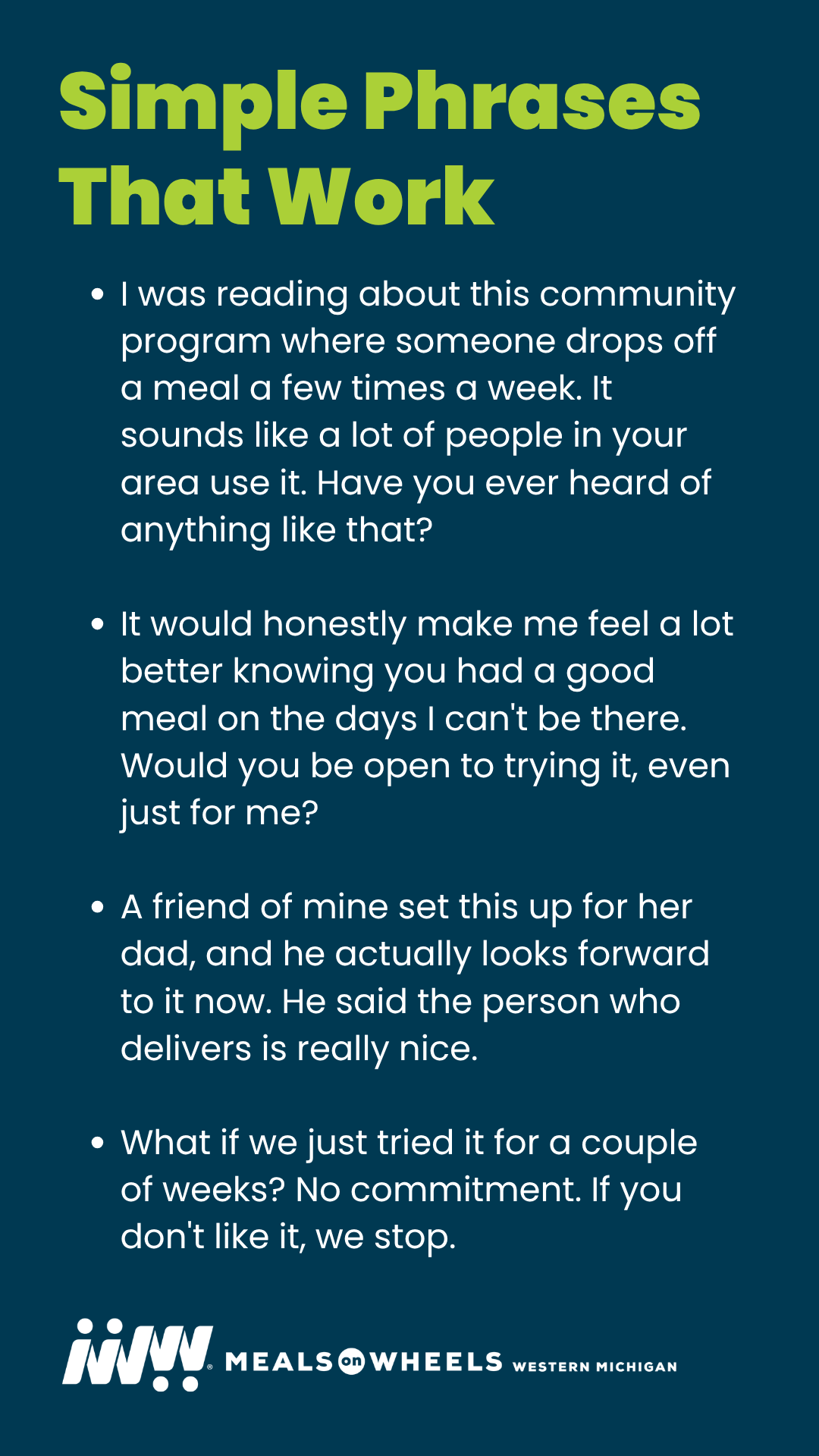
“I was reading about this community program where someone drops off a home delivered meal a few times a week. It sounds like a lot of people in your area use it. Have you ever heard of anything like that?”
This takes the pressure off your parent. You’re not prescribing a solution. You’re sharing something and inviting their opinion.
Make it about you, not them.
“It would honestly make me feel a lot better knowing you had a good meal on the days I can’t be there. Would you be open to trying it, even just for me?” Sometimes the easiest way for a proud parent to say yes is when they feel like they’re doing it for someone they love, not for themselves.
Normalize it.
“A friend of mine set this up for her dad, and he actually looks forward to it now. He said the person who delivers is really nice.”
Hearing that other people, people like them, have said yes and liked it can quietly dismantle the idea that accepting help means giving something up.
Start small.
“What if we just tried it for a couple of weeks? No commitment. If you don’t like it, we stop.”
A trial feels manageable. It removes the weight of a permanent decision and gives your parent a sense of control over the process.
What to avoid saying
Some phrases, even when they come from a place of genuine love, tend to backfire. A few worth steering around:
- “You need help.” This can feel like a verdict, even when you don’t mean it that way. It puts your parent in the position of defending themselves rather than considering what you’re offering.
- “I can’t keep worrying about you like this.” While honest, this can land as guilt. It shifts the emotional burden onto your parent and can make them feel like they’ve become a source of stress rather than someone who’s loved.
- “You’re not eating right.” Even if it’s true, this sounds like a critique. It invites argument rather than openness.
- “This is what’s best for you.” No one, at any age, wants to hear that someone else has already decided what’s best for them. It removes their voice from a decision about their own life.
The common thread here is control. Phrases that take it away tend to shut the conversation down. Phrases that offer it back tend to keep it open.
What Meals on Wheels Western Michigan actually looks like
Part of the resistance often comes from what people imagine the service to be. There can be an assumption that the food may not be fresh or tasty, or that the process is complicated and challenging to select meals each week. Another assumption could be that this is only reserved for people who are truly in crisis. It’s worth gently correcting that picture.
Meals on Wheels Western Michigan is a community program. A friendly driver shows up with a nutritionally balanced meal and takes a moment to check in. It’s brief, it’s warm, and for many clients, it becomes one of the best parts of their day. Not because they were desperate, but because it feels good to see a familiar face and know that someone in their community is thinking of them when you can’t be there.
The meals themselves are made with senior health and well-being in mind, so they’re not generic, one-size-fits-all offerings. And the service is flexible. It meets people where they are, not where someone else thinks they should be.
Many of the people who receive meals through the program were connected to it by their adult children, not by a doctor or a social worker, but by a son or daughter who simply wanted to make sure their parent was eating well and seeing a friendly face on a regular basis.
That’s not charity; that’s community. It’s the kind of thing a good neighbor would do, just organized in a way that makes it reliable.
Ready to take the next step?
You don’t have to have the perfect conversation. You just have to start one. And knowing that there’s something simple, practical, and genuinely positive on the other side of it can make that first sentence a little easier to say.
If you’re thinking about meal support for your parent, we’re here to walk you through what it looks like and answer any questions you have. There’s no pressure and no commitment to get started.
[Learn more about how meal delivery works and what to expect →]